When emails arrive, your code runs
Mailhooks turns inbound email into events — no mail server, no DNS, no infrastructure.
Give your app an email address. When something lands, we parse it, filter the spam, and deliver it where you already work — webhooks, Notion, n8n, or Discord.
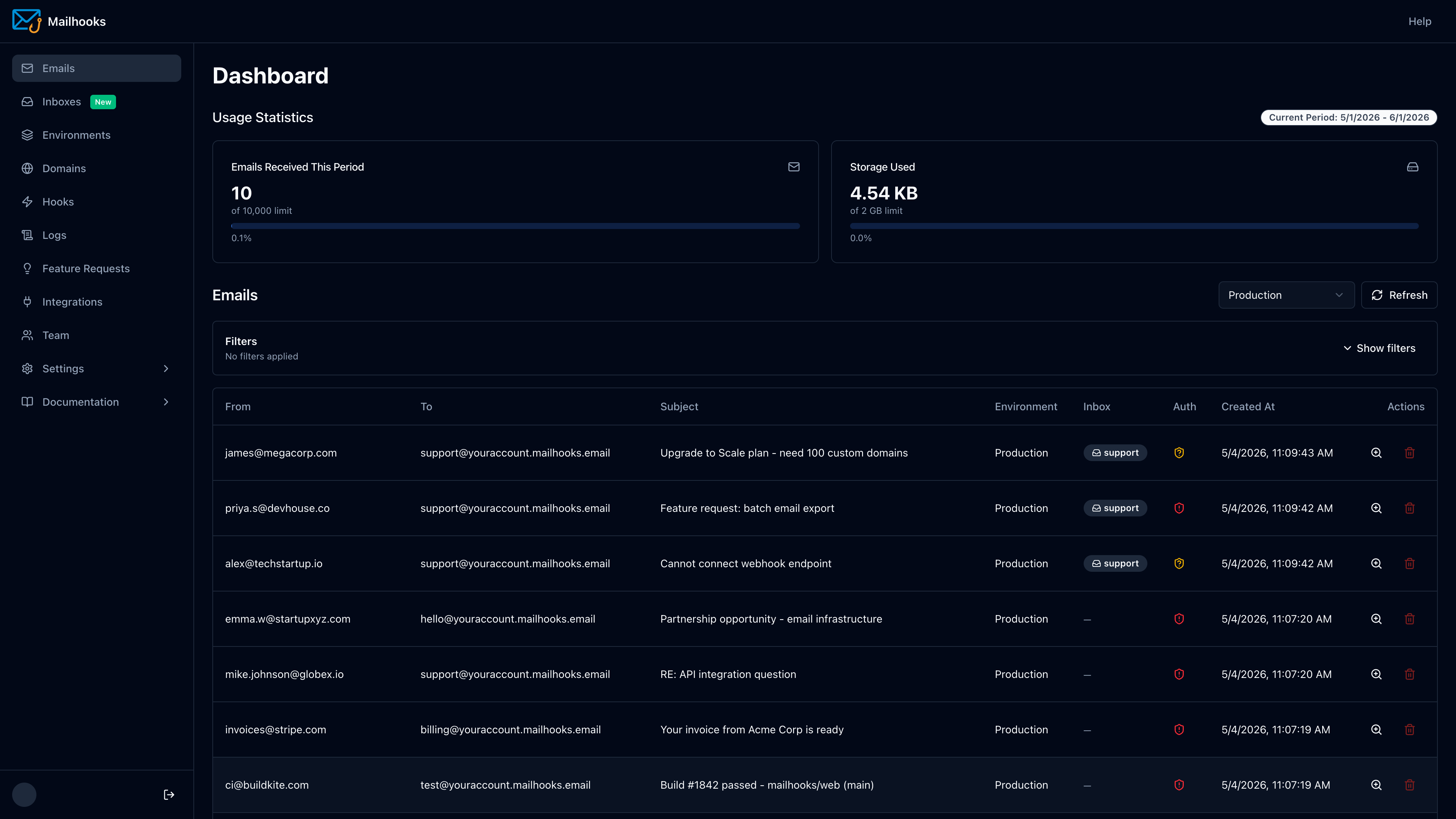
Live Demo Inbox
See how Mailhooks receives and processes emails in real-time
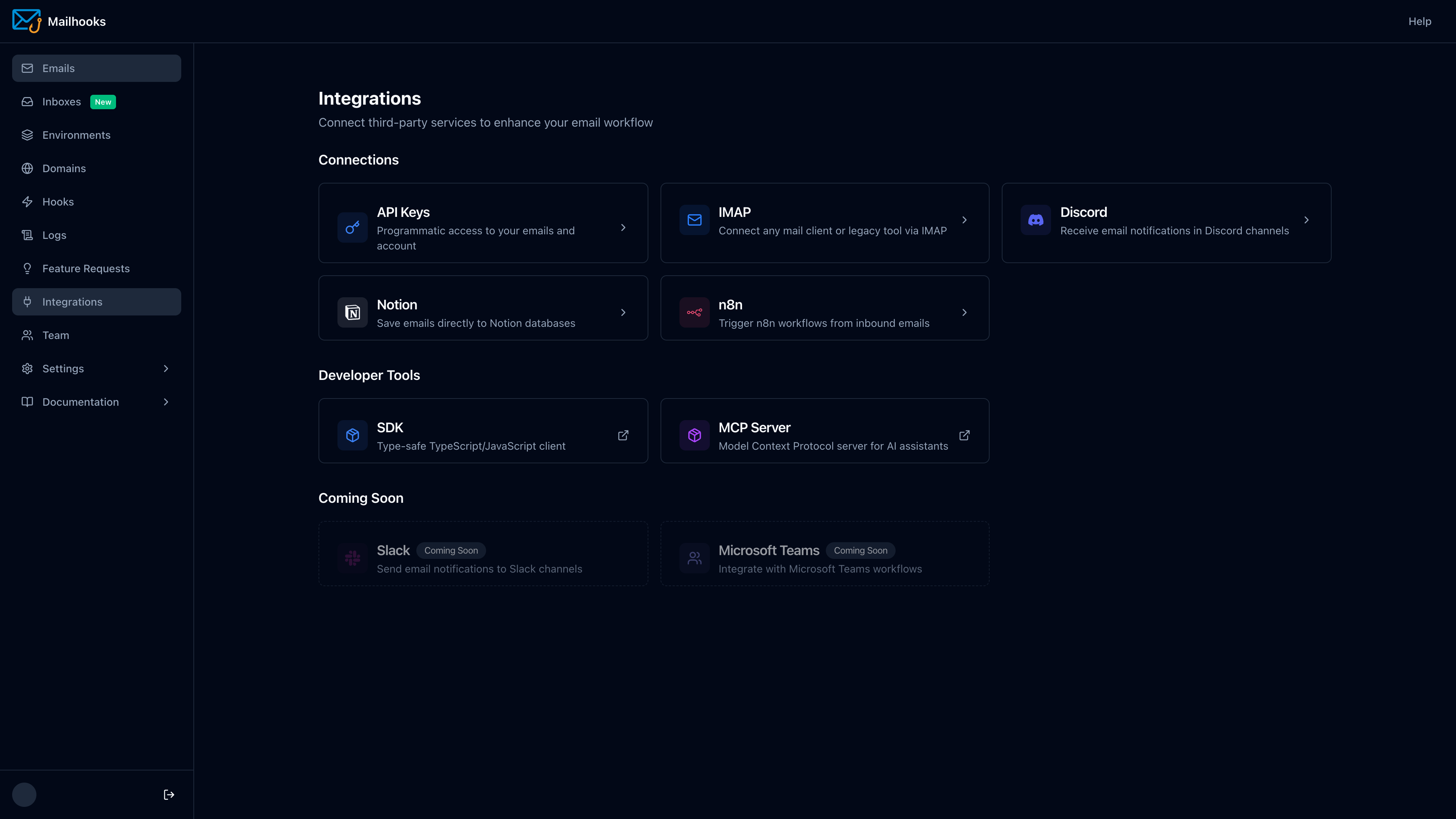
Email lands where you already work
No glue code. Emails arrive as database rows, workflow triggers, or channel messages — ready for whatever you're building.
Inbound only. That's the whole point.
Most email APIs started as sending platforms — you carry their baggage (deliverability, IP reputation, DKIM alignment) even when you only want to receive. Mailhooks never sends. So you never think about any of it.
No SPF / DKIM / DMARC setup
Receiving doesn't need any of it. Point your MX record and you're done.
No IP reputation to manage
We're not in the sending game, so you're never at risk of being blacklisted.
Your webhooks only fire for real emails
Spam is filtered before it reaches your automation — not after.
No outbound features to pay for
You're not subsidising a sending platform. You pay for what you use.
What people build with it
Real things email can trigger — no infrastructure required.
When an email arrives, this runs
Copy, paste, deploy — your mailhook is live in two minutes
// Receive emails via webhook
app.post('/webhook/email', (req, res) => {
  const { from, subject, text, html } = req.body;

  // Process the incoming email
  console.log('New email from:', from);

  res.sendStatus(200);
});
Three ways email reaches your stack
Three ways to receive emails — pick what fits your architecture, your stack, or the 15-year-old tool you can't rewrite
Webhooks
- Best for servers with public endpoints
- One-shot HTTP requests
- Works with serverless functions
- Automatic retries on failure
Use when: You have infrastructure to receive HTTP requests
Real-time (SSE)
- Outbound connections only
- No ngrok needed for local dev
- Works in browsers and firewalled envs
- Built-in auto-reconnection
Use when: You can't expose endpoints or need client-side notifications
IMAP
- Plug into legacy software that only speaks IMAP
- osTicket, old Jira, RT,
imaplibscripts - Zero code changes on the downstream tool
- Your API key is the password
Use when: The downstream system predates webhooks and you're not rewriting it
Make email trigger something today
Your first mailhook in two minutes. No credit card required.